Mar 31
Posted: under photography, Wildlife.
Tags: beauty, butterflies, photography, wildlife management March 31st, 2009
Monarchs come through central Texas in both the spring and fall migrations. In spring, they particularly need wild milkweeds on which to lay eggs, but they also need flowers that provide nectar, in case they must fly farther to find the milkweeds (and this year, that’s important. Because of drought, the milkweed abundance is way […] [...more]
Monarchs come through central Texas in both the spring and fall migrations. In spring, they particularly need wild milkweeds on which to lay eggs, but they also need flowers that provide nectar, in case they must fly farther to find the milkweeds (and this year, that’s important. Because of drought, the milkweed abundance is way down on our place.)
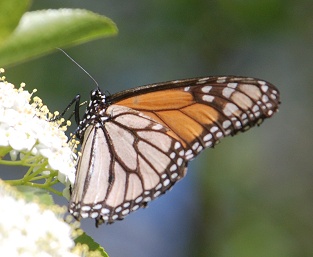
I usually see monarchs mating while perched on Ashe junipers–as wind protection–and nectaring on whatever’s blooming. Some years, they have a choice. This year, because of the drought, not much choice. The reliable woody shrubs bloom even when the flowering forbs are scarce. Rusty blackhaw viburnum and wild plum (both the Mexican plum and the thicketing plum) provided monarch feeding stations this year.
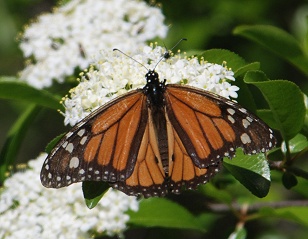
This particular viburnum overhangs the creekbed (now dry) and is at least twenty feet tall. Sunday it was covered with white flower clusters. Since we’ve owned the place, excluding livestock from the creek woods has allowed the growth of new viburnums, so in another ten to twenty years, we should have a lot of flowering shrubs–and some very happy monarchs.
Read the rest of this entry »

Mar 22
Posted: under photography, Plantlife.
Tags: beauty, native plants, photography March 22nd, 2009
Spring has leapt forward this week. On the way to church in the city, I saw drifts of bluebonnets…but the following pictures are from our place, taken in the last day or so. They’re small and scattered, but beautiful–and very popular with the local small wildlife (insects, for instance.) I haven’t had time yet to […] [...more]
Spring has leapt forward this week. On the way to church in the city, I saw drifts of bluebonnets…but the following pictures are from our place, taken in the last day or so. They’re small and scattered, but beautiful–and very popular with the local small wildlife (insects, for instance.)
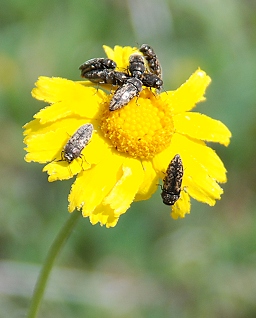
I haven’t had time yet to look up which eager little eaters these are.
Read the rest of this entry »
Mar 18
Posted: under Plantlife.
Tags: beauty, native plants, trees March 18th, 2009
Here’s the view we’ve had out the back door the past few days, minus the clothes on the line and the corner of the barn. The pinky-purple is redbud, the green is roughleaf dogwood (not yet flowering), and the gold is a flowering red oak. All are native, though these are yard plantings chosen to […] [...more]
Here’s the view we’ve had out the back door the past few days, minus the clothes on the line and the corner of the barn.
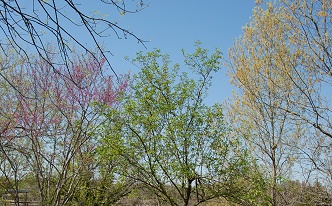
The pinky-purple is redbud, the green is roughleaf dogwood (not yet flowering), and the gold is a flowering red oak. All are native, though these are yard plantings chosen to look good in (most) seasons.
Read the rest of this entry »
Mar 18
Posted: under photography, Wildlife.
Tags: Animal behavior, observation, odonates, photography March 18th, 2009
The first odes of spring showed up after the rain, not surprisingly: the first was a tiny Citrine Forktail male seen flying from one (too brief to grab a shot) perch on dead week stalks sticking out of water, late Sunday. On Tuesday evening, behind the #3 gabion, I spotted three pairs of Plateau Spreadwings*, […] [...more]
The first odes of spring showed up after the rain, not surprisingly: the first was a tiny Citrine Forktail male seen flying from one (too brief to grab a shot) perch on dead week stalks sticking out of water, late Sunday. On Tuesday evening, behind the #3 gabion, I spotted three pairs of Plateau Spreadwings*, Lestes alacer, all trying to oviposit on one tiny clump of Eleocharis…the only clump that had greened up.
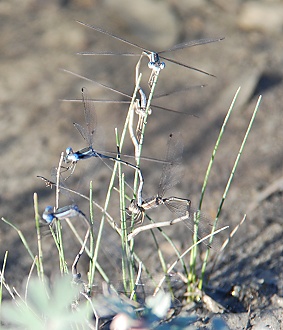
Spreadwing Damselflies ovipositing
The third female is out of sight behind that blurred leaf at the bottom (you can just see one eye and a few segments of abdomen.) The males have bright blue eyes and a pale blue or pale green stripe on the thorax; the females are shades of brown/tan/beige.
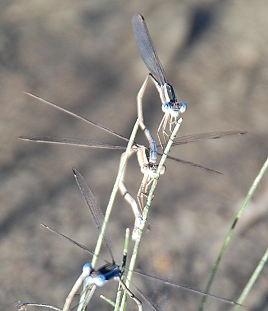
The male holds on while the female makes a slit in the stem of the plant and inserts eggs. These stems are so thin it’s hard to imagine any room for eggs inside, but after the long drought, no water plants with thicker stems had emerged from last week’s rain. Only this single little clump. Unfortunately, we’re not expecting any rain, and it’s already warm–the little rain pool behind the picture is already drying up/sinking into the soil.
I spotted a male Common Bluet at another rain pool, but the pictures weren’t clear enough to post.
*EDITED: The spreadwings were IDed as Plateau Spreadwings by Dennis Paulson, from the TexOdes list, via email. Thanks!
Mar 16
Posted: under Activities, Plantlife, Water, Weather.
Tags: beauty, observation, photography, water resource management, Weather March 16th, 2009
Plants around here take immediate advantage of water, so the change in color after less than a week from the first drop of rain is striking. Not only does green show on the mowed maintenance path, but at the base of the taller clumps to either side. Rain started Wednesday; this was taken Sunday. Last […] [...more]
Plants around here take immediate advantage of water, so the change in color after less than a week from the first drop of rain is striking.
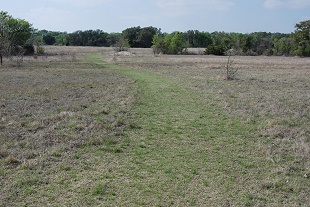
Near Meadow
Not only does green show on the mowed maintenance path, but at the base of the taller clumps to either side. Rain started Wednesday; this was taken Sunday. Last week, no green.
Read the rest of this entry »
Mar 13
Posted: under Water, Weather.
Tags: drought, rain, Weather March 13th, 2009
We hit the jackpot this time. Before dark today, Richard recorded a storm total (over three days ) of 4 inches at Owl Pavilion, 3.7 at Fox Pavilion. The two house gauges, one north of our house and one west of the other house, were measured at roughly noon, both over 3 inches. This is […] [...more]
We hit the jackpot this time. Before dark today, Richard recorded a storm total (over three days ) of 4 inches at Owl Pavilion, 3.7 at Fox Pavilion. The two house gauges, one north of our house and one west of the other house, were measured at roughly noon, both over 3 inches.
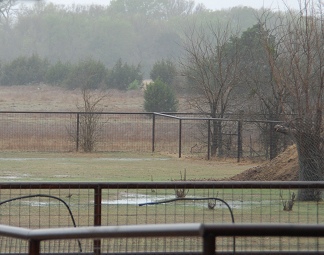
This is a shot from the end of the front porch, across the barn pen fence, into the south horse lot, about four Friday afternoon. Puddles!!! Green!!! (that field was gray-tan three days ago. Our grass is ambitious.)
Read the rest of this entry »
Mar 11
Posted: under Water, Weather.
Tags: Weather March 11th, 2009
Last night the front blew in. I was awake with a cramp (one of those you get up and loosen, think is gone, lie down, and it comes back) and all the windows were open–it had been near 80 in the day and was still in the 70s when we went to bed. So I […] [...more]
Last night the front blew in. I was awake with a cramp (one of those you get up and loosen, think is gone, lie down, and it comes back) and all the windows were open–it had been near 80 in the day and was still in the 70s when we went to bed. So I was muttering to the cramped muscle, when a little trickle of cool air came in the NE window. Cold fronts here send scouts slithering under the warm air masses, lifting their skirts, as it were, testing to see if the warm air mass can be moved, before the real wind starts. The front wasn’t supposed to arrive that soon, but nothing that cool had been around for weeks.
Then I heard it in the distance, an advancing roar. The curtain fluttered, then lifted out into the room an inch or so. The roar came nearer; the hall bathroom window shade banged on the frame, and I scuttled around in the dark shutting all the north-side windows, and smelling what I hoped was rain on the wind.
Read the rest of this entry »
Mar 09
Posted: under photography, Plantlife, Wildlife.
Tags: beauty, native plants, photography, wildlife management March 9th, 2009
We saw a Luna Moth again today. It might have been the same one or another one. This was in the mid-morning of a cloudy day, with a strong wind from the S (the other side of the fence. The white “frosting” on the forewing purple stripe is (when really enlarged) white scales mixed with […] [...more]
We saw a Luna Moth again today. It might have been the same one or another one. This was in the mid-morning of a cloudy day, with a strong wind from the S (the other side of the fence.
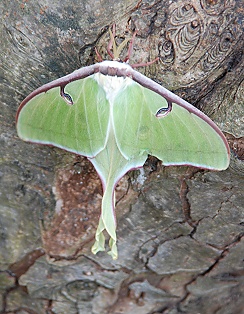
Luna Moth
The white “frosting” on the forewing purple stripe is (when really enlarged) white scales mixed with the purplish ones. You can just see the underwing eyespots showing through.
Read the rest of this entry »
Mar 07
Posted: under photography, Wildlife.
Tags: beauty, photography March 7th, 2009
Until today, I had never seen a Luna Moth. On the evening of my birthday, Richard found one clinging to a twig low under a rusty blackhaw viburnum. I rushed out with the camera. We think this moth had just emerged and begun the “stretching out” process, but we know very little about them. Richard […] [...more]
Until today, I had never seen a Luna Moth. On the evening of my birthday, Richard found one clinging to a twig low under a rusty blackhaw viburnum. I rushed out with the camera.
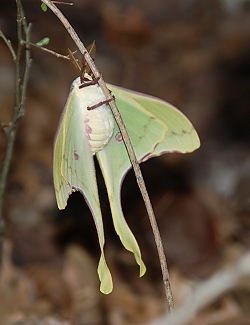
Luna Moth
We think this moth had just emerged and begun the “stretching out” process, but we know very little about them. Richard said they were fairly common in rural Alabama when he was a child, with “moth-watching parties” in the evenings.
Read the rest of this entry »
Mar 04
Posted: under Land, Plantlife, Weather, Wildlife.
Tags: beauty, native plants, photography, Weather, wildlife management March 4th, 2009
Even in a year this dry, some of the native plants (and a few non-natives) do their best to keep alive and growing. One of the natives we’ve nurtured for years in the yard is the scarlet buckeye, an understory tree that hates sun and drought–but thrives in shady canyons near permanent water. Our version […] [...more]
Even in a year this dry, some of the native plants (and a few non-natives) do their best to keep alive and growing.
One of the natives we’ve nurtured for years in the yard is the scarlet buckeye, an understory tree that hates sun and drought–but thrives in shady canyons near permanent water. Our version of that is the shade of a big old ash and regular watering. I’d like to move its progeny into the creek woods, but right now they’re far too dry (and too far away to water.) It’s just showing its flower buds now; they’ll be open in a few days.
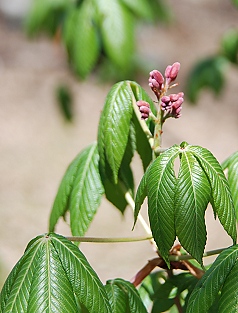
Read the rest of this entry »
 RDF/RSS Feed
 Atom Feed