Feb 26
Posted: under photography, Plantlife, Wildlife.
Tags: Animal behavior, beauty, native plants, photography February 26th, 2009
Mexican plum, the tree-sized wild plum around here, blooms even in drought years. Not only is it snowy white and beautiful, it has that amazing wild-plum fragrance…and as it’s an early bloomer, it attracts everything that’s hungry for nectar. It doesn’t look like this long–especially in a drought year–and the tiny white petals are already […] [...more]
Mexican plum, the tree-sized wild plum around here, blooms even in drought years. Not only is it snowy white and beautiful, it has that amazing wild-plum fragrance…and as it’s an early bloomer, it attracts everything that’s hungry for nectar.
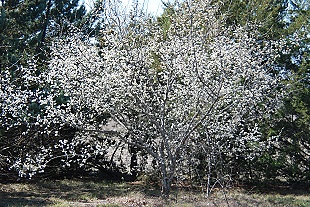
Mexican Plum in full bloom
It doesn’t look like this long–especially in a drought year–and the tiny white petals are already blowing off it in today’s stiff warm breeze.
Read the rest of this entry »

Feb 22
Posted: under photography, Wildlife.
Tags: observation, photography February 22nd, 2009
Even in a drought year, trees put out buds–at this time of year, the elms and hackberries and the early oaks may flower, and some of the migrant birds enjoy a lofty “salad” of buds from them. Here’s one of our taller elms showing golden-green lace against the blue sky. [...more]
Even in a drought year, trees put out buds–at this time of year, the elms and hackberries and the early oaks may flower, and some of the migrant birds enjoy a lofty “salad” of buds from them. Here’s one of our taller elms showing golden-green lace against the blue sky.
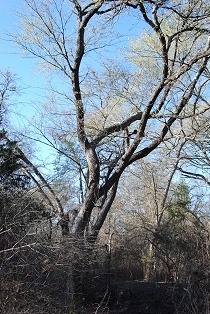
Early spring elm
Read the rest of this entry »
Feb 13
Posted: under Wildlife.
Tags: photography, snake February 13th, 2009
Though we have some large snakes on the place, most of the snake species are small, and we’re lucky if we get a glimpse of them. This little gray snake with the black head and orange “collar” is barely a foot long and skinny as a pencil–easy to miss, if it weren’t that we’re in […] [...more]
Though we have some large snakes on the place, most of the snake species are small, and we’re lucky if we get a glimpse of them. This little gray snake with the black head and orange “collar” is barely a foot long and skinny as a pencil–easy to miss, if it weren’t that we’re in severe drought and the grass to hide it just isn’t there.
This is a Prairie Ring-necked Snake, Diadophis punctatus arnyi, a shy little creature that sometimes freezes long enough to have its picture taken.
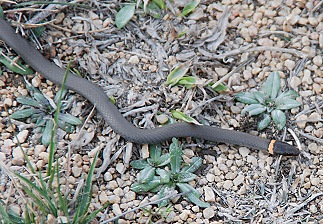
Prairie Ring-necked Snake
Read the rest of this entry »
Feb 13
Posted: under Activities, Wildlife.
Tags: Activities, bird behavior, census February 13th, 2009
The annual GBBC sponsored by Cornell University and the Audubon Society is our big bird census activity of the year. Usually I spent 1-2 hours in each of four sites on the land, but this year (since I’m under orders not to overdo as I recover from pneumonia) today’s observations at least will all be […] [...more]
The annual GBBC sponsored by Cornell University and the Audubon Society is our big bird census activity of the year. Usually I spent 1-2 hours in each of four sites on the land, but this year (since I’m under orders not to overdo as I recover from pneumonia) today’s observations at least will all be literally “yard” ones. So far that’s only eleven species….but my “special bird” in the year, the female Pyrrhuloxia, is still here. (Usually I see a really interesting bird the day before the count starts, and then not again until afterwards.)
Anyone who’s never participated should consider doing so…it’s fun and it contributes useful information on bird distribution in winter. There are maps, updated constantly, showing where observations have come from.
Feb 13
Posted: under Activities, photography, Plantlife.
Tags: Activities, drought, photography February 13th, 2009
Even in a dry year, spring comes early to central Texas. I’m recovering from pneumonia so can’t get out to the full 80 acres, but here are some pictures from around the house. (I need to plant some elbowbush up by the house, as it’s one of the very earliest.) Rusty blackhaw viburnum is one […] [...more]
Even in a dry year, spring comes early to central Texas. I’m recovering from pneumonia so can’t get out to the full 80 acres, but here are some pictures from around the house. (I need to plant some elbowbush up by the house, as it’s one of the very earliest.)
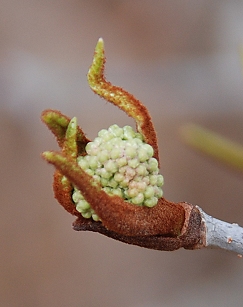
Rusty Blackhaw Viburnum bud
Rusty blackhaw viburnum is one of the most beautiful of the native shrubs, but it’s routinely scraped off by developers as “brush”. Here, the buds are just opening to show the bud-cluster that will be a puffball of pure white within a week. Easy to see why it acquired the name “rusty.” It’s a valuable plant for wildlife, producing tasty blue berries for birds–and nectar for the early butterflies and moths.
Read the rest of this entry »
Feb 05
Posted: under photography, Wildlife.
Tags: Activities, bird behavior, photography February 5th, 2009
In December 2002, I was birdwatching at the site of what would be Fox Pavilion (hadn’t been built yet.) We had a flock of cardinals that showed up every day…but that day, there was a female bird with them that wasn’t a cardinal. It was a Pyrrhuloxia, a close relative whose normal range is well […] [...more]
In December 2002, I was birdwatching at the site of what would be Fox Pavilion (hadn’t been built yet.) We had a flock of cardinals that showed up every day…but that day, there was a female bird with them that wasn’t a cardinal. It was a Pyrrhuloxia, a close relative whose normal range is well west of here.
I had only a little point and shoot camera then, and it was a heavily cloudy day, late in the afternoon, so my pictures of the female Pyrrhuloxia weren’t very good–just good enough to show that’s what it had to be. That female was somewhat melanistic, very dark indeed, noticeably darker than the female cardinals perched in the same scrubby trees.
I watched every winter, but did not see another one until today: on the feeder in the back yard. I wasn’t able to get a picture of it except through the study window–old glass, and can’t be opened so it can’t be cleaned–so it’s blurry–and handheld with my less-great lens, but here it is:
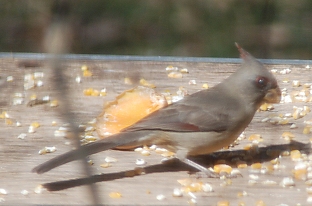
Pyrrhuloxia, female
Note that the bill is yellow, with the upper part (culmen) sharply curved, and the bird is a cool gray, with minimal red in the crest, around the eye, and in the folded wing.
Here’s a female cardinal (but this taken outside, so there’s no blurring by the old dirty glass in the window and with my best lens) as gray as they look in our yard–usually they show warmer colors–and always the red bill and more red in crest, eyes, wings, and tail.
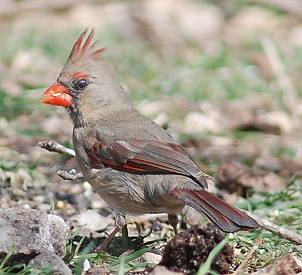
Even though the Pyrrholoxia picture isn’t as good as I’d wish, it’s still nifty to see one back again, this time in sunlight and close enough to see details with the binoculars. I expect these “desert cardinals” (as we called them when I was a kid) to appear in our area more often as climate change makes it hotter and dryer.
 RDF/RSS Feed
 Atom Feed