Mar 18
Posted: under Climate Change, Plantlife, Water.
Tags: drought, native plants, natural water March 18th, 2013
I mentioned on Twitter that more trees had failed to leaf out this spring, victims of the long drought which not only did not provide them enough water to survive, but prevented us from having any supplemental water to give them. Someone suggested what seemed reasonable–why not plant trees from the next climate zone (or […] [...more]
I mentioned on Twitter that more trees had failed to leaf out this spring, victims of the long drought which not only did not provide them enough water to survive, but prevented us from having any supplemental water to give them. Someone suggested what seemed reasonable–why not plant trees from the next climate zone (or two) to the south of us. I realized then that the traditional “planting zone/climate zone” concept had taken hold to such an extent that the complexity of keeping anything alive through a rapid change of climate wasn’t being talked about.
Read the rest of this entry »

Jun 09
Posted: under Climate Change, Plantlife, Weather.
Tags: climate, native plants, photography, Weather June 9th, 2012
This is another year of brown spring and summer…though some people got more rain, we’re still behind, and the quick brown-off after the rain we did get proves it. This is not how the land should look in early June: we should still have at least half the grass green, and the June flowers in […] [...more]
This is another year of brown spring and summer…though some people got more rain, we’re still behind, and the quick brown-off after the rain we did get proves it.
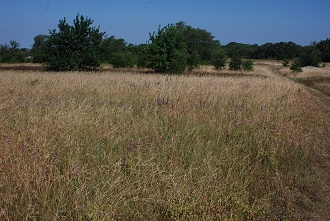
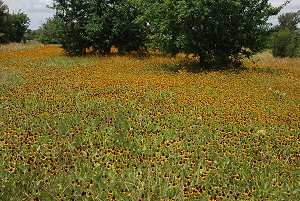
This is not how the land should look in early June: we should still have at least half the grass green, and the June flowers in full bloom. This is a typical August picture: brown land, hard blue cloudless sky full of heat. Before climate change really began to show here, mid-June to mid-July looked more like the picture at the top of the blog. But this is the third dry year, though we had enough rain in April and early May to produce thi river of gold (claspleaf coneflower) in mid-May, in the lowest part, where water had run for a few days.
Read the rest of this entry »
Oct 15
Posted: under Climate Change, photography, Wildlife.
Tags: beauty, butterflies, drought, photography October 15th, 2011
Monarchs nectaring on Gayfeather (Liatris sp.) [...more]
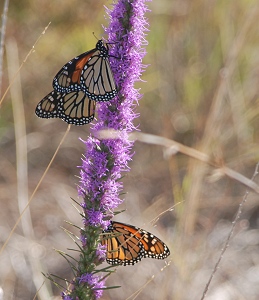
Monarchs nectaring on Gayfeather (Liatris sp.)
Read the rest of this entry »
Aug 23
Posted: under Climate Change, Mortality, photography, Plantlife, Water, Wildlife.
Tags: Activities, climate, drought, photography August 23rd, 2011
Roughleaf dogwood & oak thicket in August 2011 East margin of creek woods–August 2011-leaves turning & dropping Cactus Flat: even the prickly pear is drying out [...more]
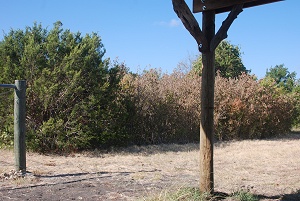 Roughleaf dogwood & oak thicket in August 2011
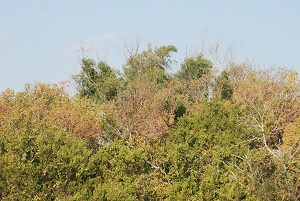 East margin of creek woods–August 2011-leaves turning & dropping
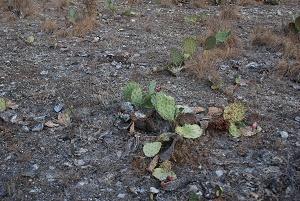 Cactus Flat: even the prickly pear is drying out
Read the rest of this entry »
Jun 13
Posted: under Climate Change.
Tags: carbon cycle, climate, prairie restoration, wildlife management June 13th, 2010
Carbon sequestration is the trapping of atmospheric carbon (carbon dioxide) into some form where it can stay for decades. Carbon sequestration occurs naturally by the actions of plants, especially long-lived vegetation, and in certain soils, where it’s deposited as slow-decaying organic matter. Plants use sunlight to convert atmospheric carbon dioxide into the chemical that make […] [...more]
Carbon sequestration is the trapping of atmospheric carbon (carbon dioxide) into some form where it can stay for decades. Carbon sequestration occurs naturally by the actions of plants, especially long-lived vegetation, and in certain soils, where it’s deposited as slow-decaying organic matter. Plants use sunlight to convert atmospheric carbon dioxide into the chemical that make up plant material–simple sugars, to start with, then starches and more complex chemicals when added to other nutrients.
Why is this of interest in wildlife management or prairie restoration? The obvious reason is climate change caused by increasing carbon dioxide levels. Carbon sequestration by changes in management of both public and private lands is one way to get carbon dioxide out of the atmosphere and into plant materials. Many of the things a land manager might do to promote wildlife or restore an original ecosystem (forest or grassland) will have multiple benefits…including carbon sequestration.
Read the rest of this entry »
May 24
Posted: under Activities, Climate Change, Water, Wildlife.
Tags: Activities, amphibians, Animal behavior, beauty, documentation, observation, photography, wildlife management May 24th, 2010
Young Rana berlandieri with last of its tail showing. [...more]
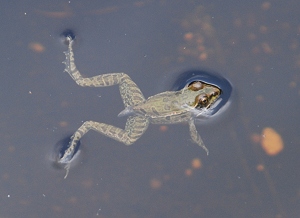 Young Rana berlandieri with last of its tail showing.
Read the rest of this entry »
Oct 08
Posted: under Climate Change, Plantlife.
Tags: beauty, climate October 8th, 2009
Taking the train from Texas to the NE has let me watch autumn develop: just starting in Texas, more and more advanced as we went north, and here, in upstate NY, gorgeous with sugar maples, sumac, poison ivy (leaves the size of dessert plates), things with berries I don’t know, green moss and ferns, russet […] [...more]
Taking the train from Texas to the NE has let me watch autumn develop: just starting in Texas, more and more advanced as we went north, and here, in upstate NY, gorgeous with sugar maples, sumac, poison ivy (leaves the size of dessert plates), things with berries I don’t know, green moss and ferns, russet this and golden that.
I chatted with another prairie person in St. Louis at the Ninc conference and in Oswego visited Rice Creek Field Station and met the new director, whose previous work was in Chihuahuan Desert ecology–and then walked the trails there. Perfect. She’s aware of research in Mexico on the effect of climate change and has promised to send me some references.
Meanwhile, I’m hearing reports from home of more rain and thus the creek may well still be running when I’m home again, a week from this Sunday.
Aug 13
Posted: under Climate Change.
Tags: climate, drought, prairie restoration August 13th, 2009
Since habitat management is part of wildlife management, restoration of degraded or poor habitat is part of our job as wildlife managers. The basic concepts were laid down years ago…but the devil’s in the details, as usual. The July 31, 2009 Science had an entire section on restoration ecology, with examples drawn from around the […] [...more]
Since habitat management is part of wildlife management, restoration of degraded or poor habitat is part of our job as wildlife managers. The basic concepts were laid down years ago…but the devil’s in the details, as usual. The July 31, 2009 Science had an entire section on restoration ecology, with examples drawn from around the world showing the benefits, costs, and difficulties in this field. Especially with the advent of global warming.
Read the rest of this entry »
 RDF/RSS Feed
 Atom Feed