Jun 12
Posted: under Wildlife.
Tags: Animal behavior, observation June 12th, 2009
We’d gone out in the hot (very!) afternoon to look at the effect of rain on the grass garden, skirting the tiny (only two fruit trees left, and never had more than six) orchard on the mound a former owner had scuffed up to put a house-for-sale on. ..but luckly, he ran out of money. […] [...more]
We’d gone out in the hot (very!) afternoon to look at the effect of rain on the grass garden, skirting the tiny (only two fruit trees left, and never had more than six) orchard on the mound a former owner had scuffed up to put a house-for-sale on. ..but luckly, he ran out of money.
So we walked on a path Richard had mowed along the west fence and then along the north fence, and then turned back toward the orchard. One of the remaining pears is on the NW corner of the “hump”, and near it are a few natives woody plants. I noticed that the kidneywood was blooming and stopped to smell it and start to photograph a handsome large wasp nectaring on its upper flowers when I heard a rustling in the dense shade under the pear. I thought it was a big lizard (we have big lizards that make a lot of noise on bark) but didn’t see it–and suddenly a little gray and red blur with a black stripe down its back ran down the far corner of the hump (where a peach tree used to be) and across the grassy area to the north horse lot, squeezing through the gate.
It was a young gray fox. I’m SO sorry I disturbed it–foxes love to nap in dense shade in the middle of the day, and this one is probably in our garden because there’s water in the water garden and ample mice and grasshoppers and other prey. And I scared it.
The fox loped the length of the north horse lot, ducked behind the big enclosure full of roses (pipe gates and wire making a big circle around the Cecile Brunner so the horses can’t eat it–there’s now a huge mound of rosebush that the birds love. I half-expected the fox to hide in there, but it ran out from behind the roses and exited our northwest corner…which put it right next to the secondary drainage outlet. Plenty of cover in there.
Still…I’m sorry I scared it. It’s a very hot day. If it hadn’t panicked, I’d never have known it was there.
No, I wasn’t quick enough to take a picture. I was staring.

Jun 12
Posted: under Activities, Plantlife.
Tags: Activities, water resource management June 12th, 2009
Because there’s no permanent natural water on our place, the main aquatic habitat we can provide for wildlife is near the house (where, if we don’t collect enough rainwater, we can use city water–in fact, the water garden began with city water supply.) It has an upper, stream-like section (small pools with low “falls” into […] [...more]
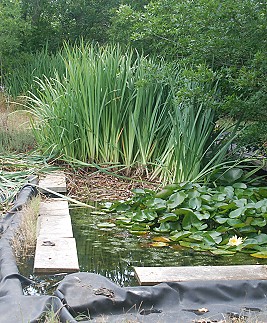
Because there’s no permanent natural water on our place, the main aquatic habitat we can provide for wildlife is near the house (where, if we don’t collect enough rainwater, we can use city water–in fact, the water garden began with city water supply.) It has an upper, stream-like section (small pools with low “falls” into each other, all in the shade) and a bottom pool that’s a 10×20 foot lily pond–with wide shallow ledges around the edge and a deep “trench” in the middle for the lilies.
To provide some vertical plantlife for dragonflies, damselflies, and other insects that need emergent vegetation, we added in pickerelweed and water iris. The water iris turned out to be very aggressive. Periodically we have to cut it back, and that’s a huge chore.
Read the rest of this entry »
Jun 09
Posted: under photography, Wildlife.
Tags: beetle, new species, photography June 9th, 2009
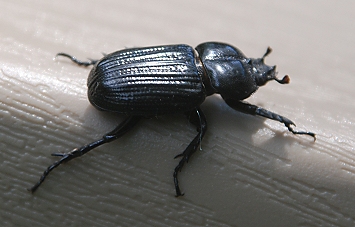
Actually not new today, but on May 23–which may, if the moth gets IDed soon, become a double-dot-day of two new species. Anyway, meet Phileurus valgus L. [...more]
Actually not new today, but on May 23–which may, if the moth gets IDed soon, become a double-dot-day of two new species.
Anyway, meet Phileurus valgus L.
Read the rest of this entry »
Jun 04
Posted: under photography, Plantlife.
Tags: beauty, native plants, photography June 4th, 2009
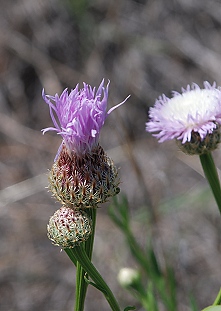
Since it looks like the rain has left us for the summer (hope not, but the long-range predictions aren’t good), I’m posting flower pictures while we have some–and we have some. An increaser in the west grass, mentioned before, is the Illinois Basketflower, Centaurea americana. this tallish forb’s buds look a lot like thistles: [...more]
Since it looks like the rain has left us for the summer (hope not, but the long-range predictions aren’t good), I’m posting flower pictures while we have some–and we have some.
An increaser in the west grass, mentioned before, is the Illinois Basketflower, Centaurea americana. this tallish forb’s buds look a lot like thistles:
Read the rest of this entry »
Jun 04
Posted: under Activities, Plantlife.
Tags: Activities, beauty, land management, native plants, prairie restoration June 4th, 2009
If land managers had ten thousand years to play with the land, prairie restoration would be a lot easier, even if they had to start with an overgrazed, eroded, compacted, heavily-invaded, polluted mess. But we don’t. So some basic principles have been laid down–initially during research on northern prairies–that now govern most prairie restoration projects: […] [...more]
If land managers had ten thousand years to play with the land, prairie restoration would be a lot easier, even if they had to start with an overgrazed, eroded, compacted, heavily-invaded, polluted mess. But we don’t. So some basic principles have been laid down–initially during research on northern prairies–that now govern most prairie restoration projects: physical removal of invasive woody plants by fire (cheap) or various mechanical clearing methods (more expensive) , grazing management to interrupt succession, physical disturbance of the soil (discing, for instance) to induce germination of dormant seeds.
Read the rest of this entry »
May 29
Posted: under photography, Wildlife.
Tags: beauty, butterflies, photography May 29th, 2009
Among everyone’s favorite wildlife (and insects) are butterflies. The drought last year meant little for butterfly larvae to eat, and thus few butterflies early in the year (and those we had were markedly smaller than the previous year.) But the rains over a month ago made it possible for some wanderers to lay eggs, and […] [...more]
Among everyone’s favorite wildlife (and insects) are butterflies. The drought last year meant little for butterfly larvae to eat, and thus few butterflies early in the year (and those we had were markedly smaller than the previous year.) But the rains over a month ago made it possible for some wanderers to lay eggs, and those eggs to survive, hatch, and the larvae to pupate…so now we have more butterflies.
I can’t get good pictures of the fast-flying species of sulfurs who are our dominant types, nor did I catch the big tiger swallowtail in the back yard, but here’s some of what was flying (and cooperative about photography) in the past week.
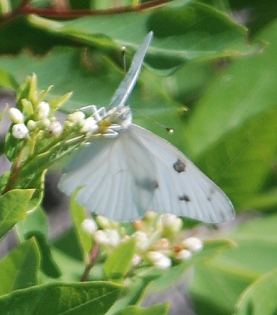
This Checkered White is trying to nectar on dogbane (the flowers mostly still in bud.)
Read the rest of this entry »
May 27
Posted: under Plantlife.
Tags: beauty, gardening, photography May 27th, 2009
Remember that garden post from May 11? Well, we’ve had tiny harvests since then–a few radishes, enough beans for a small “mess” of them–but today was the first Grand Prize for home gardeners–enough corn, beans, and tomatoes for a meal for two. Oh, happy taste buds! Happy stomachs! The Chief Gardener said this made the […] [...more]
Remember that garden post from May 11? Well, we’ve had tiny harvests since then–a few radishes, enough beans for a small “mess” of them–but today was the first Grand Prize for home gardeners–enough corn, beans, and tomatoes for a meal for two.
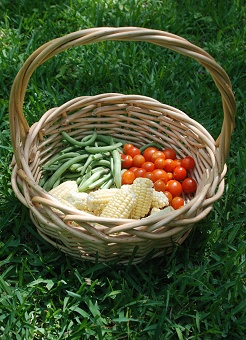
Oh, happy taste buds! Happy stomachs! The Chief Gardener said this made the work worth it. Hurray!
And yes, a lot of wildlife have enjoyed the garden as well, from bugs to birds. (So far the deer haven’t discovered it…)
May 23
Posted: under photography, Plantlife, Wildlife.
Tags: beauty, native plants, new species, photography May 23rd, 2009
The half-inch of rain last weekend brought out a few more flowers, and today the theme was purple and yellow. The most intense yellow belonged to the claspleaf coneflowers, damp-ground lovers, here in the swale below the #3 gabion. The lacy white in the foreground bears the unlovely name of beggars’ ticks, for its adherent […] [...more]
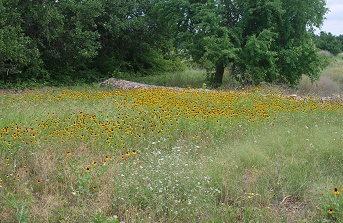
The half-inch of rain last weekend brought out a few more flowers, and today the theme was purple and yellow. The most intense yellow belonged to the claspleaf coneflowers, damp-ground lovers, here in the swale below the #3 gabion. The lacy white in the foreground bears the unlovely name of beggars’ ticks, for its adherent seeds.
Read the rest of this entry »
May 11
Posted: under photography, Water.
Tags: beauty, gardening, photography May 11th, 2009
Though nearly all our land is used for wildlife, we do have a vegetable garden. Twenty-something years ago, we put in raised beds edged with landscape timbers. Though some of those are rotting out, the main design is still there: This is the garden from the east; the near bed had radishes in it and […] [...more]
Though nearly all our land is used for wildlife, we do have a vegetable garden. Twenty-something years ago, we put in raised beds edged with landscape timbers. Though some of those are rotting out, the main design is still there:
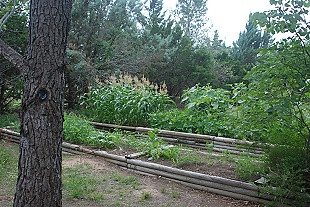
This is the garden from the east; the near bed had radishes in it and still has some carrots; to the right is a huge (HUGE) Mexican oregano plant from previous years. We did not get the winter stuff in on time because of the severe drought and water use restrictions. The next bed has corn on both ends and beans and sunflowers in the middle.
Read the rest of this entry »
May 10
Posted: under photography, Plantlife.
Tags: beauty, native plants, photography May 10th, 2009
We’ve all had the experience of visitors arriving just before, or just after, the best show of flowers/vegetables…the garden just isn’t looking its best the day they come, but it was right before (or after.) We once spent a small fortune watering a patch of bluebonnets, trying to keep it in flower in a drought […] [...more]
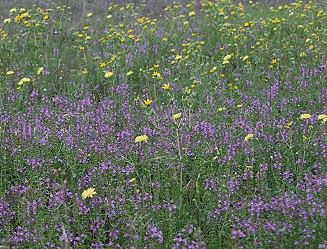
We’ve all had the experience of visitors arriving just before, or just after, the best show of flowers/vegetables…the garden just isn’t looking its best the day they come, but it was right before (or after.) We once spent a small fortune watering a patch of bluebonnets, trying to keep it in flower in a drought year for my husband’s aunt, who–when shown them–said “Is that all? Why do people make a fuss over those?”
Well, we had houseguests this past week–late for one set of flowers and early for another–but the land graciously showed them something anyway:
 Read the rest of this entry »
 RDF/RSS Feed
 Atom Feed