Jun 02
Posted: under Activities, photography, Wildlife.
Tags: Activities, census, documentation, photography, wildlife management June 2nd, 2017
Yesterday morning as I went outside, I saw a very small cicada on the kitchen storm door. I thought immediately of one seen some years back (turned out to be four years) in the same place, photographed then and identified by Bill Reynolds, an expert on cicadas at BugGuide.net. First I went back inside and […] [...more]
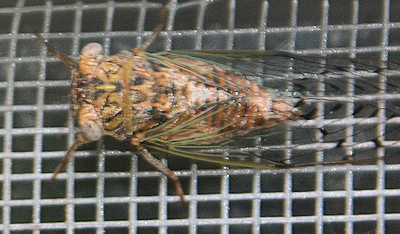
Yesterday morning as I went outside, I saw a very small cicada on the kitchen storm door. I thought immediately of one seen some years back (turned out to be four years) in the same place, photographed then and identified by Bill Reynolds, an expert on cicadas at BugGuide.net. First I went back inside and got the camera, then photographed it, then went to BugGuide to compare…and sure enough, it’s the same critter. Length about 1/2 inch (not counting wings.)
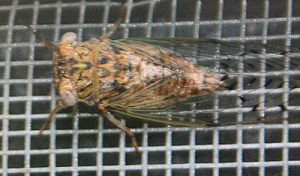 Pacarina puella Little Mesquite cicada
Read the rest of this entry »

Jul 08
Posted: under photography, Wildlife.
Tags: beauty, butterflies, census, native plants, photography, wildlife management July 8th, 2011
An unfamiliar plant shows up every now and then (more often after rains, and really often after flood events that move seeds from upstream above our property down into the damp areas.) Over the weekend, my husband reported a plant new to him over on Westbrook near the south fenceline: a Composite, very small flowers […] [...more]
An unfamiliar plant shows up every now and then (more often after rains, and really often after flood events that move seeds from upstream above our property down into the damp areas.) Over the weekend, my husband reported a plant new to him over on Westbrook near the south fenceline: a Composite, very small flowers and bicolored, like a miniature gaillardia, he said. Plant up to three feet tall, straggly, with narrow (lanceolate to linear) leaves. A couple of days later he brought back a drying specimen of the flowers; I tried to revive it in water so I could look it up, but no luck.
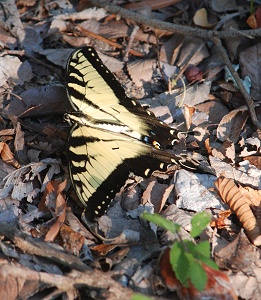
I finally made it over there early this morning, and as usual saw more than I came for. First, while walking through the south end of the creek woods, I heard a bird I didn’t recognize (along with white-eyed vireos, cardinals, Carolina wrens, mockingbirds…) and then I saw a flash of yellow and black…not a bird, but a large butterfly. We’ve had more and more tiger swallowtails in the past few years, both in the house yards and down in the creek woods, but I’ve had little luck photographing them. They’re strong flyers, skittish, and prefer to perch (when they perch) with plenty of greenery between me and them. Today I got lucky.
 Read the rest of this entry »
Jan 17
Posted: under Activities, Land, Plantlife, Water, Wildlife.
Tags: Activities, beauty, butterflies, census, new species, photography, Weather January 17th, 2010
We’d had some sprinkles, but the first real rain came Thursday & Friday, about two inches, and set the secondary drainage flowing across the near meadow again. Creek was up and a little turbid, but the flow in the grass was crystal clear. Today, I finally photographed a common (supposedly) species of butterfly around here, […] [...more]
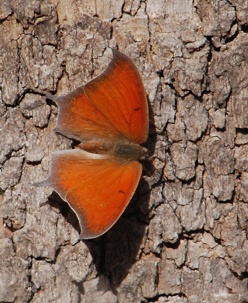
We’d had some sprinkles, but the first real rain came Thursday & Friday, about two inches, and set the secondary drainage flowing across the near meadow again. Creek was up and a little turbid, but the flow in the grass was crystal clear. Today, I finally photographed a common (supposedly) species of butterfly around here, which I’d never been able to catch in the lens.
 Read the rest of this entry »
Dec 30
Posted: under photography, Plantlife, Wildlife.
Tags: beauty, bird behavior, census, great blue heron, LeConte's sparrow, native plants, photography December 30th, 2009
During migration and winter we have a lot of birds in the grass–birds that fly up and dive down a little distance away, birds that fly up and perch in bushes, birds that fly up and away and dive down over there. Most of them are sparrows of some kind. Today one of the “divers” […] [...more]
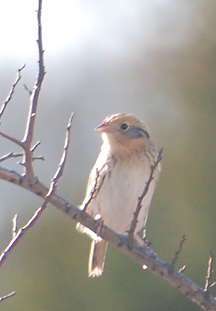
During migration and winter we have a lot of birds in the grass–birds that fly up and dive down a little distance away, birds that fly up and perch in bushes, birds that fly up and away and dive down over there. Most of them are sparrows of some kind. Today one of the “divers” posed long enough for me to note salient characteristics and even get some slightly blurry pictures–good enough for an ID:
Read the rest of this entry »
Nov 07
Posted: under Activities, Wildlife.
Tags: Activities, bird behavior, census, observation, photography, wildlife management November 7th, 2009
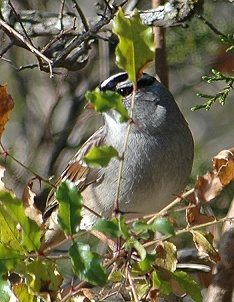
Forgot to mention yesterday that though I had heard a White-crowned Sparrow call in the yard a few days ago, I hadn’t spotted one until yesterday evening, up in the dry woods. I came into the south end of the dry woods trail and startled some White-winged doves, who flapped off with their usual noisy […] [...more]
Forgot to mention yesterday that though I had heard a White-crowned Sparrow call in the yard a few days ago, I hadn’t spotted one until yesterday evening, up in the dry woods. I came into the south end of the dry woods trail and startled some White-winged doves, who flapped off with their usual noisy behavior, but one smaller bird just hopped to the top of a cactus and sat there.
 Read the rest of this entry »
Nov 06
Posted: under Activities, photography, Plantlife, Wildlife.
Tags: Activities, beauty, butterflies, census, native plants, photography, prairie restoration November 6th, 2009
Some grasses should be planted just for the way they look with sunlight slanting through them in the fall. This is one. It’s one of the Muhlys, but I don’t know which. [...more]
Some grasses should be planted just for the way they look with sunlight slanting through them in the fall.
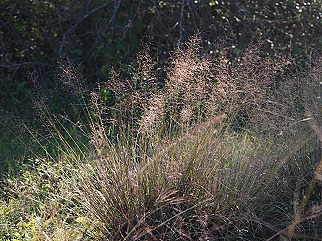
This is one. It’s one of the Muhlys, but I don’t know which.
Read the rest of this entry »
Nov 06
Posted: under Activities, photography, Wildlife.
Tags: Activities, census, insect, new species, observation, photography, wildlife management November 6th, 2009
Our on the land with visitors yesterday, I spotted a new fly (new to me): That spotted abdomen was very obvious with the naked eye. It’s a similar pattern to a spotted jumping spider we have (also white spots on black) and until I saw it fly I was thinking “There’s another P. audax, never […] [...more]
Our on the land with visitors yesterday, I spotted a new fly (new to me):
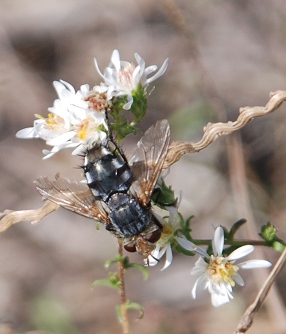
That spotted abdomen was very obvious with the naked eye. It’s a similar pattern to a spotted jumping spider we have (also white spots on black) and until I saw it fly I was thinking “There’s another P. audax, never saw one on heath aster before.” The “face” and antennae are the same golden color as the wings.
Read the rest of this entry »
Apr 09
Posted: under Plantlife, Update, Wildlife.
Tags: census, native plants, wildlife management April 9th, 2009
http://www.80acresonline.org/ Species lists are now live on the website. When you mouse over the Species List, three choices appear: birds, plants, and “zoology” (which in this instance means non-bird wildlife.) And each of these lists has three pictures of representative species up there on the top green line. So if you’re been wondering what we […] [...more]
http://www.80acresonline.org/
Species lists are now live on the website. When you mouse over the Species List, three choices appear: birds, plants, and “zoology” (which in this instance means non-bird wildlife.)
And each of these lists has three pictures of representative species up there on the top green line.
So if you’re been wondering what we have…there it is.
Feb 13
Posted: under Activities, Wildlife.
Tags: Activities, bird behavior, census February 13th, 2009
The annual GBBC sponsored by Cornell University and the Audubon Society is our big bird census activity of the year. Usually I spent 1-2 hours in each of four sites on the land, but this year (since I’m under orders not to overdo as I recover from pneumonia) today’s observations at least will all be […] [...more]
The annual GBBC sponsored by Cornell University and the Audubon Society is our big bird census activity of the year. Usually I spent 1-2 hours in each of four sites on the land, but this year (since I’m under orders not to overdo as I recover from pneumonia) today’s observations at least will all be literally “yard” ones. So far that’s only eleven species….but my “special bird” in the year, the female Pyrrhuloxia, is still here. (Usually I see a really interesting bird the day before the count starts, and then not again until afterwards.)
Anyone who’s never participated should consider doing so…it’s fun and it contributes useful information on bird distribution in winter. There are maps, updated constantly, showing where observations have come from.
Dec 28
Posted: under Equipment.
Tags: census, observation, photography December 28th, 2008
If you have land, you have equipment (if it’s no more than a shovel, a clamshell posthole digger, and a fence tool.) And equipment fails. I went out today to check the water at both Fox and Owl, put out more feed for the winter-resident birds, and change the memory cards in the two game-cams. […] [...more]
If you have land, you have equipment (if it’s no more than a shovel, a clamshell posthole digger, and a fence tool.) And equipment fails.
I went out today to check the water at both Fox and Owl, put out more feed for the winter-resident birds, and change the memory cards in the two game-cams. We got those last spring (well, we borrowed a friend’s for a month to try it out) and they’ve been very helpful. They have a feature that lets you enter a security code so the camera won’t work for anyone else and they have a digital display that has a variety of messages and lets you see that you’re entering the security code correctly.
About two months ago, the display began to “break up”–not all the pixels of all the letters would show. The camera still worked, though, and I could still enter the code. I thought maybe the batteries were running low, so I changed them…but the display still looked spotty. It’s gotten much worse in the last month (I change out the memory cards on the last weekend of the month) and today I was unable to get the first camera to accept the code and go back to work. The second did it, but if it goes the way of the other, it won’t work after the next changeout.
Just in case the local store had old, not strong batteries, I’ll buy new batteries at a store with more turnover, but I’m afraid some internal chip may be degrading for some reason. It continued to take pictures (I’ve looked at what’s on the memory card–perfectly good video and still pictures, which is why I doubt it’s the batteries.) These cameras are supposed to be able to handle any outdoor setting and until this happened I was pleased with them and hoped to order a couple more.
 RDF/RSS Feed
 Atom Feed
 Pacarina puella Little Mesquite cicada