Jun 19
Posted: under Activities, Land, photography, Plantlife, Wildlife.
Tags: Activities, beauty, bird behavior, native plants, natural water, photography June 19th, 2016
The rain stopped a week ago; the winter grasses are brown or browning, the early wildflowers have gone to seed. But soil moisture is still good. The tallgrasses (switchgrass, Eastern gama, Indiangrass, big bluestem) are doing very well (switchgrass in the secondary drainage is taller than we are.) There’s an area in the east grass […] [...more]
The rain stopped a week ago; the winter grasses are brown or browning, the early wildflowers have gone to seed. But soil moisture is still good. The tallgrasses (switchgrass, Eastern gama, Indiangrass, big bluestem) are doing very well (switchgrass in the secondary drainage is taller than we are.) There’s an area in the east grass we call “The Bowl” because it’s a roundish area that seeps in wet weather as it slopes down to the old drainage line. It stays green longer. When we got the place, it was covered with broomweed (non-native), bare under the broomweed with a few scattered grass plants, not doing well because of the chemical defense of the broomweek. Today it looks like this:

You can see the upslope edge (pale beige of dry grass)
Every different shade of green, every native plant, reveals something about the soil where it is.
Read the rest of this entry »

Mar 14
Posted: under photography, Wildlife.
Tags: beauty, bird behavior, observation, photography March 14th, 2010
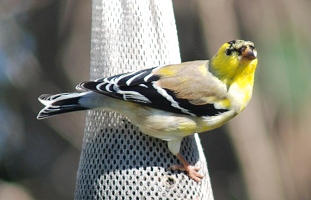
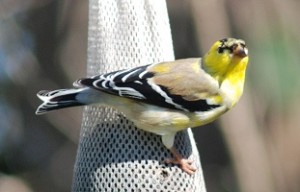
Spring is one of our busiest bird seasons, with winter residents often still around, spring migrants moving through, year-rounders breeding, and the first of the summer residents showing up. [...more]
Spring is one of our busiest bird seasons, with winter residents often still around, spring migrants moving through, year-rounders breeding, and the first of the summer residents showing up.
 Read the rest of this entry »
Mar 06
Posted: under photography, Plantlife, Wildlife.
Tags: beauty, bird behavior, native plants, photography March 6th, 2010
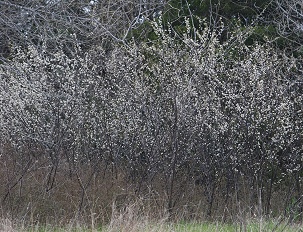
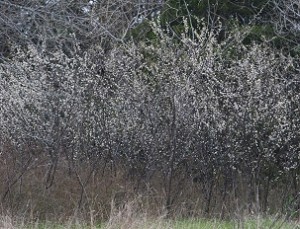
The thicketing plums in full bloom–this thicket began with a few stems of plum stuck in the ground. [...more]
The thicketing plums in full bloom–this thicket began with a few stems of plum stuck in the ground.
 Read the rest of this entry »
Dec 30
Posted: under photography, Plantlife, Wildlife.
Tags: beauty, bird behavior, census, great blue heron, LeConte's sparrow, native plants, photography December 30th, 2009
During migration and winter we have a lot of birds in the grass–birds that fly up and dive down a little distance away, birds that fly up and perch in bushes, birds that fly up and away and dive down over there. Most of them are sparrows of some kind. Today one of the “divers” […] [...more]
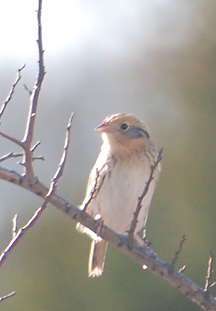
During migration and winter we have a lot of birds in the grass–birds that fly up and dive down a little distance away, birds that fly up and perch in bushes, birds that fly up and away and dive down over there. Most of them are sparrows of some kind. Today one of the “divers” posed long enough for me to note salient characteristics and even get some slightly blurry pictures–good enough for an ID:
Read the rest of this entry »
Dec 27
Posted: under Activities, Plantlife, Wildlife.
Tags: Activities, beauty, bird behavior, native plants, natural water, photography December 27th, 2009
We had clear dry weather today to get some work done, and no choir duties. Our first chore was moving water iris taken from the lily pond (which had overgrown with them) out onto the land, to see if they’ll naturalize in some of the temporary pools. We were successful with a few transplants a […] [...more]
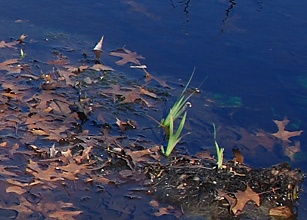
We had clear dry weather today to get some work done, and no choir duties. Our first chore was moving water iris taken from the lily pond (which had overgrown with them) out onto the land, to see if they’ll naturalize in some of the temporary pools. We were successful with a few transplants a few years back.
 Read the rest of this entry »
Nov 29
Posted: under photography, Weather.
Tags: beauty, bird behavior, natural water, photography, seasons November 29th, 2009
We had gorgeous weather for Thanksgiving, and an out-of-state guest who enjoyed a moderately long stroll around the place. We weren’t in rubber boots, so we couldn’t cross the creek or wander as freely, but still a fun hour or so out wandering. Saturday, in not-as-perfect (but still pleasant) weather I made it across the […] [...more]
We had gorgeous weather for Thanksgiving, and an out-of-state guest who enjoyed a moderately long stroll around the place. We weren’t in rubber boots, so we couldn’t cross the creek or wander as freely, but still a fun hour or so out wandering.
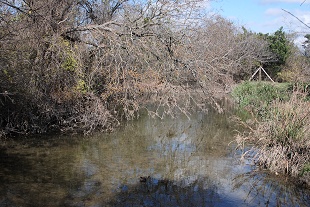
Saturday, in not-as-perfect (but still pleasant) weather I made it across the creek in regular shoes–not exactly dry-shod, but not too wet-footed. I did put three knapsacks of rocks from the rockpile near the creek onto the ford, which has migrated a bit with the flash floods this fall. Water quality looked great, clear, spring-fed, and flowing strongly. This view is upstream from the ford (shown in previous post); the braced fencepost to the right, on grass, shows the north fenceline where it crosses the creek…there’s a mess of flotsam caught on the water gap.
 Read the rest of this entry »
Nov 15
Posted: under Wildlife.
Tags: bird behavior, observation, seasons November 15th, 2009
Driving home from church today, I saw several more “winter hawks” in the sky or perched along the road, which brought up the topic of our disparate bird populations through the seasons. We have year-rounders, winter residents, winter visitors, summer nesters, and migrants in fall and spring. [...more]
Driving home from church today, I saw several more “winter hawks” in the sky or perched along the road, which brought up the topic of our disparate bird populations through the seasons. We have year-rounders, winter residents, winter visitors, summer nesters, and migrants in fall and spring.
Read the rest of this entry »
Nov 07
Posted: under Activities, Wildlife.
Tags: Activities, bird behavior, census, observation, photography, wildlife management November 7th, 2009
Forgot to mention yesterday that though I had heard a White-crowned Sparrow call in the yard a few days ago, I hadn’t spotted one until yesterday evening, up in the dry woods. I came into the south end of the dry woods trail and startled some White-winged doves, who flapped off with their usual noisy […] [...more]
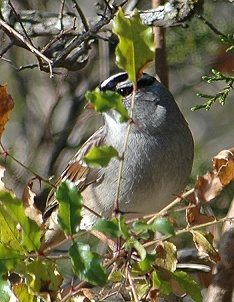
Forgot to mention yesterday that though I had heard a White-crowned Sparrow call in the yard a few days ago, I hadn’t spotted one until yesterday evening, up in the dry woods. I came into the south end of the dry woods trail and startled some White-winged doves, who flapped off with their usual noisy behavior, but one smaller bird just hopped to the top of a cactus and sat there.
 Read the rest of this entry »
Aug 26
Posted: under photography, Water, Wildlife.
Tags: beauty, bird behavior, observation, photography August 26th, 2009
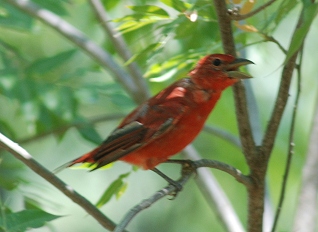
Some of the birds on the place usually stay away from the house, but in this severe drought we have the only substantial water (the creek’s dry at the south end of town, a mile downstream–and probably beyond that, too.) In the past week, with a slightly decreased workload, I’ve been out looking for migrants […] [...more]
Some of the birds on the place usually stay away from the house, but in this severe drought we have the only substantial water (the creek’s dry at the south end of town, a mile downstream–and probably beyond that, too.) In the past week, with a slightly decreased workload, I’ve been out looking for migrants in the back yard–hearing more different songs. Today I was lucky enough to photograph this gorgeous male summer tanager:
Read the rest of this entry »
Feb 13
Posted: under Activities, Wildlife.
Tags: Activities, bird behavior, census February 13th, 2009
The annual GBBC sponsored by Cornell University and the Audubon Society is our big bird census activity of the year. Usually I spent 1-2 hours in each of four sites on the land, but this year (since I’m under orders not to overdo as I recover from pneumonia) today’s observations at least will all be […] [...more]
The annual GBBC sponsored by Cornell University and the Audubon Society is our big bird census activity of the year. Usually I spent 1-2 hours in each of four sites on the land, but this year (since I’m under orders not to overdo as I recover from pneumonia) today’s observations at least will all be literally “yard” ones. So far that’s only eleven species….but my “special bird” in the year, the female Pyrrhuloxia, is still here. (Usually I see a really interesting bird the day before the count starts, and then not again until afterwards.)
Anyone who’s never participated should consider doing so…it’s fun and it contributes useful information on bird distribution in winter. There are maps, updated constantly, showing where observations have come from.
 RDF/RSS Feed
 Atom Feed