Jun 29
Posted: under Mortality, photography, Wildlife.
Tags: Animal behavior, beauty, butterflies, dragonfly, photography, predation, spider June 29th, 2010
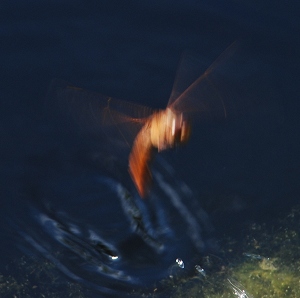
We had thunder and rain this afternoon for several hours, but around six, sun broke through enough to illuminate the newly refilled lily pond. I went out to see what was going on with pondlife. Two male Neon Skimmers, Libellula croceipennis, were harrassing the four or five male Blue Dashers, Pachydiplax longipennis, and also pestering […] [...more]
We had thunder and rain this afternoon for several hours, but around six, sun broke through enough to illuminate the newly refilled lily pond. I went out to see what was going on with pondlife. Two male Neon Skimmers, Libellula croceipennis, were harrassing the four or five male Blue Dashers, Pachydiplax longipennis, and also pestering the two female Neon Skimmers who were ovipositing in the pond.
Read the rest of this entry »

Jun 15
Posted: under Pollution.
Tags: migration, Pollution June 15th, 2010
Although we are over two-hundred straight-line miles from the Gulf, we are smack dab in the middle of the Central Flyway, by which birds pass north and south from their breeding grounds to their wintering grounds. So with the first news of the oil gusher in the Gulf, my thoughts leaped past the wildlife present […] [...more]
Although we are over two-hundred straight-line miles from the Gulf, we are smack dab in the middle of the Central Flyway, by which birds pass north and south from their breeding grounds to their wintering grounds. So with the first news of the oil gusher in the Gulf, my thoughts leaped past the wildlife present to be damaged by the oil immediately, to those who would be arriving from the north–exhausted and hungry–to find their migration stopovers and their wintering grounds untenable.
Read the rest of this entry »
Jun 13
Posted: under Climate Change.
Tags: carbon cycle, climate, prairie restoration, wildlife management June 13th, 2010
Carbon sequestration is the trapping of atmospheric carbon (carbon dioxide) into some form where it can stay for decades. Carbon sequestration occurs naturally by the actions of plants, especially long-lived vegetation, and in certain soils, where it’s deposited as slow-decaying organic matter. Plants use sunlight to convert atmospheric carbon dioxide into the chemical that make […] [...more]
Carbon sequestration is the trapping of atmospheric carbon (carbon dioxide) into some form where it can stay for decades. Carbon sequestration occurs naturally by the actions of plants, especially long-lived vegetation, and in certain soils, where it’s deposited as slow-decaying organic matter. Plants use sunlight to convert atmospheric carbon dioxide into the chemical that make up plant material–simple sugars, to start with, then starches and more complex chemicals when added to other nutrients.
Why is this of interest in wildlife management or prairie restoration? The obvious reason is climate change caused by increasing carbon dioxide levels. Carbon sequestration by changes in management of both public and private lands is one way to get carbon dioxide out of the atmosphere and into plant materials. Many of the things a land manager might do to promote wildlife or restore an original ecosystem (forest or grassland) will have multiple benefits…including carbon sequestration.
Read the rest of this entry »
Jun 06
Posted: under photography, Plantlife, Wildlife.
Tags: beauty, butterflies, insect, photography, prairie restoration June 6th, 2010
A few pictures from a week ago, May 30, and also from yesterday, June 5, as what’s blooming and in what abundance changes rapidly–especially in the hot, dry weather we’re having. (We did get 3/10 of an inch of rain. It barely wet the ground.) Variegated Fritillary, Euptoita claudia, on Gaillardia [...more]
A few pictures from a week ago, May 30, and also from yesterday, June 5, as what’s blooming and in what abundance changes rapidly–especially in the hot, dry weather we’re having. (We did get 3/10 of an inch of rain. It barely wet the ground.)
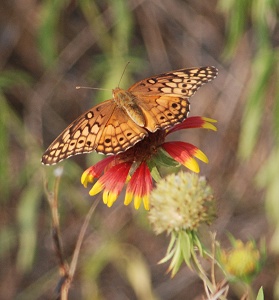 Variegated Fritillary, Euptoita claudia, on Gaillardia
Read the rest of this entry »
 RDF/RSS Feed
 Atom Feed