Dec 31
Posted: under Wildlife.
Tags: bird behavior, observation, photography December 31st, 2008
It starts out simply, a few hours free to take a walk around and see how things are doing, though since we have not had significant rain for months, and less than half the average annual rainfall, how they’re doing is dry. Still, there’s always beauty, even muted by thirst. I head out across the […] [...more]
It starts out simply, a few hours free to take a walk around and see how things are doing, though since we have not had significant rain for months, and less than half the average annual rainfall, how they’re doing is dry. Still, there’s always beauty, even muted by thirst. I head out across the near meadow, taking a look at a thicket of young cedar elms we decided to let grow for bird habitat…and spot a nest I hadn’t noticed before. Now the tall grass has laid over, and the leaves have fallen and a beautifully constructed nest shows up, perhaps 18 -24 inches above ground in a small cedar elm that’s got branches even lower than that. It’s about 4 inches across, a deep cup, built of twigs on the outside–tiny ones–and then grass, and lined with fine grass stems.
From there I go on to the main grassland, noticing the stunted size of the bluebonnet rosettes that should be twice that size by now to give us a good show in the spring. Without more rain, it’ll be a sparse flowering. Up a diagonal mowed path to the corner of the dry woods, and then down center walk (as we call it) to the creek woods. The entrance meadow is in its winter hiatus, except for greenbriar, and I remind myself that I need to mow this down in the next week or two.
Read the rest of this entry »

Dec 28
Posted: under Equipment.
Tags: census, observation, photography December 28th, 2008
If you have land, you have equipment (if it’s no more than a shovel, a clamshell posthole digger, and a fence tool.) And equipment fails. I went out today to check the water at both Fox and Owl, put out more feed for the winter-resident birds, and change the memory cards in the two game-cams. […] [...more]
If you have land, you have equipment (if it’s no more than a shovel, a clamshell posthole digger, and a fence tool.) And equipment fails.
I went out today to check the water at both Fox and Owl, put out more feed for the winter-resident birds, and change the memory cards in the two game-cams. We got those last spring (well, we borrowed a friend’s for a month to try it out) and they’ve been very helpful. They have a feature that lets you enter a security code so the camera won’t work for anyone else and they have a digital display that has a variety of messages and lets you see that you’re entering the security code correctly.
About two months ago, the display began to “break up”–not all the pixels of all the letters would show. The camera still worked, though, and I could still enter the code. I thought maybe the batteries were running low, so I changed them…but the display still looked spotty. It’s gotten much worse in the last month (I change out the memory cards on the last weekend of the month) and today I was unable to get the first camera to accept the code and go back to work. The second did it, but if it goes the way of the other, it won’t work after the next changeout.
Just in case the local store had old, not strong batteries, I’ll buy new batteries at a store with more turnover, but I’m afraid some internal chip may be degrading for some reason. It continued to take pictures (I’ve looked at what’s on the memory card–perfectly good video and still pictures, which is why I doubt it’s the batteries.) These cameras are supposed to be able to handle any outdoor setting and until this happened I was pleased with them and hoped to order a couple more.
Dec 28
Posted: under Land.
Tags: Add new tag, land management, reporting December 28th, 2008
In Texas, if you have your land recorded with the county tax appraiser as “wildlife management,” which qualified for a lower tax rate on the property, you must have a written plan (based on the seven requirements of the enabling legislation) and submit an annual report on what you’ve actually done to comply with your […] [...more]
In Texas, if you have your land recorded with the county tax appraiser as “wildlife management,” which qualified for a lower tax rate on the property, you must have a written plan (based on the seven requirements of the enabling legislation) and submit an annual report on what you’ve actually done to comply with your plan.
Tax appraisers are out to get the most tax income for their county, so they look with great suspicion on agricultural land, and especially wildlife management land. They have zero interest in wildlife, and are under pressure from county government to provide the money the country wants for roads, bridges, EMS service, county law enforcement, etc. So it’s imperative that the annual report adhere to the legal guidelines for wildlife management and convince them that yes, this is a real project, not a tax shelter.
A previous state comptroller decided that counties must require landowners to use the report form from Texas Parks & Wildlife–the one approved by the legislature and hence not negotiable. This form really fits large properties managing for game animals better than small properties. So I add supporting documentation that adapts the form to a small property.
Read the rest of this entry »
Dec 24
Posted: under Wildlife.
Tags: beauty, bird behavior, observation December 24th, 2008
We have white-winged doves on our place…with the change in climate over the past 20 years, they’ve started wintering here as well (they used to migrate south in winter.) White-wings are large “dove-colored” doves–the largest native dove in the area–and except for the white flash in the wing (showing as a white stripe even on […] [...more]
We have white-winged doves on our place…with the change in climate over the past 20 years, they’ve started wintering here as well (they used to migrate south in winter.) White-wings are large “dove-colored” doves–the largest native dove in the area–and except for the white flash in the wing (showing as a white stripe even on the folded wing) they’ve always struck me as being rather plain, dull birds. They come in flocks; they’re bullies at a feeding station; they all look alike (no gender difference) and they don’t have particularly interesting songs or anything.
Silly me. Nothing in nature is really dull and plain, once we really look at it. This year the observation of white-wings has shown me something both new and colorful.
Read the rest of this entry »
Dec 22
Posted: under Policies.
Tags: blog policies December 22nd, 2008
There’s a new page laying out the policies for comments; the link is above. Because the spam load’s been low here, I’m not posting the whole thing separately, but take a look if you’re thinking of making your first comment and are wondering if it’s OK. [...more]
There’s a new page laying out the policies for comments; the link is above. Because the spam load’s been low here, I’m not posting the whole thing separately, but take a look if you’re thinking of making your first comment and are wondering if it’s OK.
Dec 21
Posted: under Wildlife.
Tags: census, observation, photography December 21st, 2008
Observing wildlife–and the sign they leave behind–is one of the satisfactions of having some land. It’s also a necessary part of our wildlife management program. Census is one of the seven essential activities under the Texas Parks & Wildlife private lands wildlife program. This makes sense–if you don’t know what you have, or (roughly) how […] [...more]
Observing wildlife–and the sign they leave behind–is one of the satisfactions of having some land. It’s also a necessary part of our wildlife management program. Census is one of the seven essential activities under the Texas Parks & Wildlife private lands wildlife program.
This makes sense–if you don’t know what you have, or (roughly) how many of it, you can’t manage it very well.
Cameras help with observation even when the animal isn’t there: photographing tracks, scat, nests, etc., can document the presence of something you don’t often (or ever!) see. So can simple interventions. We discovered that animals regularly used the paths we mowed for ourselves and the planks we put across muddy dips for our own convenience. In wet weather, they left footprints; they often left scat. One great horned owl neatly dropped two regurgitated owl pellets onto one plank. Read the rest of this entry »
Dec 21
Posted: under Land, Mortality, Wildlife.
December 21st, 2008
In nature, things die. Plants die; animals die; rocks crumble. As a manager, it’s important for me to know what died and have some idea why. If it was a plant was it killed by disease, drought, insect damage, overuse by a native critter? Was it a juvenile, an adult, an aged adult? If it […] [...more]
In nature, things die. Plants die; animals die; rocks crumble. As a manager, it’s important for me to know what died and have some idea why. If it was a plant was it killed by disease, drought, insect damage, overuse by a native critter? Was it a juvenile, an adult, an aged adult? If it was an animal, did some other critter kill it (and if so, as it prey or a rival in a turf dispute?) or did it die of disease or old age or non-natural injury (vehicular injury, gunshot wound, poison, etc.?)
Walking in the creek woods yesterday, I found another set of bones. Both skull and lower jaw, all teeth intact, a shoulder blade, a leg bone (broken, chewed), a rib. As I had other work to do, I brought only the skull back with me, to be sure of species (I’m still learning skull shape–my guess was right, but the dental formula proved it.) Read the rest of this entry »
Dec 20
Posted: under Activities, photography, Wildlife.
Tags: Activities, Animal behavior, census, observation, photography December 20th, 2008
I’ve started working on a long-term project to define who eats what and is eaten by whom. Published sources are not as much help as you might think, since they’re not really local and the local mix of food sources varies from both historical record (we have different plants, in different proportions, and thus different […] [...more]
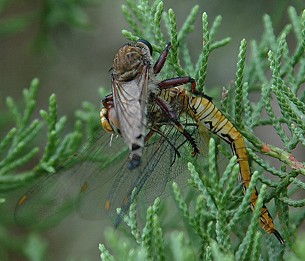
Robberfly taking a large dragonfly
I’ve started working on a long-term project to define who eats what and is eaten by whom. Published sources are not as much help as you might think, since they’re not really local and the local mix of food sources varies from both historical record (we have different plants, in different proportions, and thus different proportions of animals for the meat-eaters to prey on) and from published sources set in a different area.
It’s being every bit as difficult I suspected it would be. Critters do not all come and pose in front of the camera with an array of their food sources so consumption can be documented. Nor are they limited to the foods we put out. Killing a lot of native critters to do stomach content analyses (a very accurate way of finding out what *that* individual ate, but non-reproducible in that individual) isn’t something I want to do, or have the time and expertise to do anyway. Read the rest of this entry »
Dec 16
Posted: under Wildlife.
Tags: bird behavior December 16th, 2008
In severe weather (as today), flocks of doves come in to feed. They crowd together, little heads bobbing up and down, and their level gray-taupe backs look like a moving carpet. The Inca doves are prettier; the white-wings en masse can look all too much like a carpet of feathered rats. [...more]
In severe weather (as today), flocks of doves come in to feed. They crowd together, little heads bobbing up and down, and their level gray-taupe backs look like a moving carpet. The Inca doves are prettier; the white-wings en masse can look all too much like a carpet of feathered rats.
Dec 14
Posted: under Land, Plantlife.
Tags: success December 14th, 2008
This is an experiment, in part. We had a lovely display down the drive again this year–something I planted for, years back–and I’m going to try to insert an image file into this post. We shall see if it works…hmmmnot this time. Edited: trying again. And Lo! The magic worked and the picture appeared. Hurray! [...more]
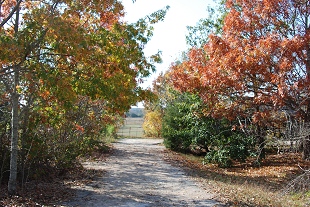
This is an experiment, in part. We had a lovely display down the drive again this year–something I planted for, years back–and I’m going to try to insert an image file into this post. We shall see if it works…hmmmnot this time.
Edited: trying again.
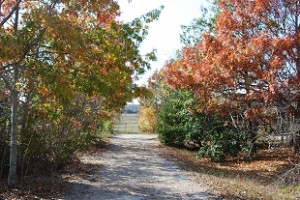
December Driveway
And Lo! The magic worked and the picture appeared. Hurray!
 RDF/RSS Feed
 Atom Feed