Feb 13
Posted: under Activities, photography, Plantlife.
Tags: Activities, drought, photography February 13th, 2009
Even in a dry year, spring comes early to central Texas. I’m recovering from pneumonia so can’t get out to the full 80 acres, but here are some pictures from around the house. (I need to plant some elbowbush up by the house, as it’s one of the very earliest.) Rusty blackhaw viburnum is one […] [...more]
Even in a dry year, spring comes early to central Texas. I’m recovering from pneumonia so can’t get out to the full 80 acres, but here are some pictures from around the house. (I need to plant some elbowbush up by the house, as it’s one of the very earliest.)
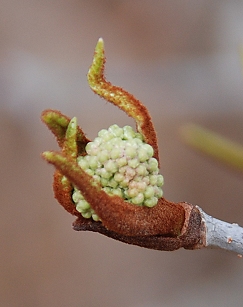
Rusty Blackhaw Viburnum bud
Rusty blackhaw viburnum is one of the most beautiful of the native shrubs, but it’s routinely scraped off by developers as “brush”. Here, the buds are just opening to show the bud-cluster that will be a puffball of pure white within a week. Easy to see why it acquired the name “rusty.” It’s a valuable plant for wildlife, producing tasty blue berries for birds–and nectar for the early butterflies and moths.
Read the rest of this entry »

Feb 05
Posted: under photography, Wildlife.
Tags: Activities, bird behavior, photography February 5th, 2009
In December 2002, I was birdwatching at the site of what would be Fox Pavilion (hadn’t been built yet.) We had a flock of cardinals that showed up every day…but that day, there was a female bird with them that wasn’t a cardinal. It was a Pyrrhuloxia, a close relative whose normal range is well […] [...more]
In December 2002, I was birdwatching at the site of what would be Fox Pavilion (hadn’t been built yet.) We had a flock of cardinals that showed up every day…but that day, there was a female bird with them that wasn’t a cardinal. It was a Pyrrhuloxia, a close relative whose normal range is well west of here.
I had only a little point and shoot camera then, and it was a heavily cloudy day, late in the afternoon, so my pictures of the female Pyrrhuloxia weren’t very good–just good enough to show that’s what it had to be. That female was somewhat melanistic, very dark indeed, noticeably darker than the female cardinals perched in the same scrubby trees.
I watched every winter, but did not see another one until today: on the feeder in the back yard. I wasn’t able to get a picture of it except through the study window–old glass, and can’t be opened so it can’t be cleaned–so it’s blurry–and handheld with my less-great lens, but here it is:
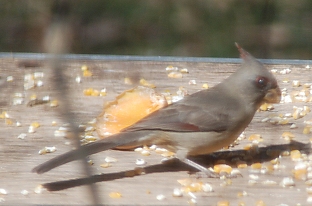
Pyrrhuloxia, female
Note that the bill is yellow, with the upper part (culmen) sharply curved, and the bird is a cool gray, with minimal red in the crest, around the eye, and in the folded wing.
Here’s a female cardinal (but this taken outside, so there’s no blurring by the old dirty glass in the window and with my best lens) as gray as they look in our yard–usually they show warmer colors–and always the red bill and more red in crest, eyes, wings, and tail.
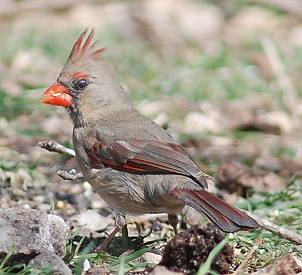
Even though the Pyrrholoxia picture isn’t as good as I’d wish, it’s still nifty to see one back again, this time in sunlight and close enough to see details with the binoculars. I expect these “desert cardinals” (as we called them when I was a kid) to appear in our area more often as climate change makes it hotter and dryer.
Jan 18
Posted: under Activities, photography, Plantlife, Wildlife.
Tags: Activities, photography, wildlife management January 18th, 2009
Yesterday was the “nose to the grindstone” day for putting the annual report in final form, including choosing which pictures to include to show the story of the year on our place. The official form has nine pages. Add to that a cover sheet with our names and other useful information the form itself doesn’t […] [...more]
Yesterday was the “nose to the grindstone” day for putting the annual report in final form, including choosing which pictures to include to show the story of the year on our place.
The official form has nine pages. Add to that a cover sheet with our names and other useful information the form itself doesn’t have space for, and three pages of supplementary notes referencing specific points of the form (which, for instance, does not have a check-box for “check-dams/gabions” under “erosion control”–just ponds, dykes, and levees, so I have to add a note about our check-dams and gabions every year) , and then 14 pages that I call the Activity Report, detailing (well, outlining, but in more detail than their Annual Report Form makes possible) the activities we’ve done in each of the seven management areas with (where possible) photographs.
(Photos beyond the break)
Read the rest of this entry »
Jan 13
Posted: under Wildlife.
Tags: beauty, bird behavior, observation, photography January 13th, 2009
I have only four records in eight years for the Hermit Thrush on our place, including today, all in the creek woods. In 2003, I saw one briefly near Main Ford, right in the middle of the woods, on January 27 and again on February 2…almost certainly the same individual. In late October 2007, I […] [...more]
I have only four records in eight years for the Hermit Thrush on our place, including today, all in the creek woods. In 2003, I saw one briefly near Main Ford, right in the middle of the woods, on January 27 and again on February 2…almost certainly the same individual. In late October 2007, I saw one in the south part of the creek woods, and got a (not very good) picture. We’re “supposed” to have them–we’re in their winter range–but these birds are small, shy, and easily missed among the winter sparrows. They’re quiet and secretive. I had read descriptions of the Hermit Thrush’s song but never heard it.
Until today.
Read the rest of this entry »
Jan 12
Posted: under Activities, Plantlife, Wildlife.
Tags: Activities, Animal behavior, beauty, observation, photography, supplemental feeding, wildlife management January 12th, 2009
Today’s wildlife experience was an armadillo, drinking noisily (they slurp, sounding rather like dogs) from the overflow guzzler at Fox Pavilion when we came back around that way after a long, two-hour stroll around the place. I thought I’d turned the water off completely, but some grit must’ve been in the faucet, because the water […] [...more]
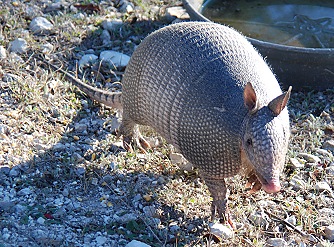
Today’s wildlife experience was an armadillo, drinking noisily (they slurp, sounding rather like dogs) from the overflow guzzler at Fox Pavilion when we came back around that way after a long, two-hour stroll around the place. I thought I’d turned the water off completely, but some grit must’ve been in the faucet, because the water had overflowed.
Read the rest of this entry »
Jan 09
Posted: under Activities, Wildlife.
Tags: bird behavior, photography, supplemental feeding, wildlife management January 9th, 2009
We have four or five different bird populations on the place, and the first year I thought the winter-resident bunch were the dullest. After all, it’s not their breeding season, so those that have a bright breeding plumage don’t have it here. Then there are the sparrows–for two years they defeated my attempts at bird […] [...more]
We have four or five different bird populations on the place, and the first year I thought the winter-resident bunch were the dullest. After all, it’s not their breeding season, so those that have a bright breeding plumage don’t have it here. Then there are the sparrows–for two years they defeated my attempts at bird identification because I didn’t spend enough time learning which small streaky brown bird was which.
Then I spent a winter sitting out in the dry woods with binoculars day after day and discovered the beauty of winter sparrows. Now the winter birds are one of my favorite subgroups. They can’t compete with the painted buntings we get in late spring (nothing can!) but I enjoy them. And the American goldfinches, arriving all brown, with the black-and-white echelons of their wingtips on the back, gradually transform toward spring into the familiar yellow and black northerners see.
Read the rest of this entry »
Jan 05
Posted: under Weather.
Tags: ice storm, photography, Weather January 5th, 2009
…NOT give us an ice storm. An ice storm after drought is particularly tough on trees weakened by drought. What we’re having is a mix of rain and freezing rain, with temps at ground level just below freezing. Already the junipers are drooping, limbs weighed down by the ice. Here’s a picture of some backyard […] [...more]
…NOT give us an ice storm. An ice storm after drought is particularly tough on trees weakened by drought.
What we’re having is a mix of rain and freezing rain, with temps at ground level just below freezing. Already the junipers are drooping, limbs weighed down by the ice. Here’s a picture of some backyard trees.
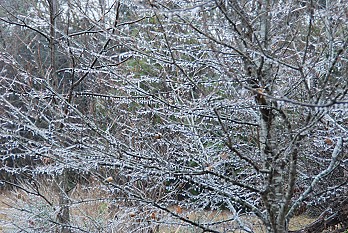
Ice storm
Read the rest of this entry »
Jan 01
Posted: under Activities, Equipment, Land.
Tags: Activities, land management January 1st, 2009
The remnant pocket prairie in the creek woods that we call the “entrance meadow (it’s almost enclosed by woods and is the formal entrance to the thickest part of them) was for the first six years the best seed bank we had of original native plants. Little bluestem, Indiangrass, sideoats grama, Maximilian sunflower, pitcher sage, […] [...more]
The remnant pocket prairie in the creek woods that we call the “entrance meadow (it’s almost enclosed by woods and is the formal entrance to the thickest part of them) was for the first six years the best seed bank we had of original native plants. Little bluestem, Indiangrass, sideoats grama, Maximilian sunflower, pitcher sage, Illinois basketflower, brown-eyed Susan, gayfeather, and others are all found in this small area. Now that we have established other seed-source areas, we’re not as dependent on it, but we still want to maintain it as a pocket prairie, not let it be overgrown with greenbriar, cedar elm, roughleaf dogwood.
So, every winter, I mow it, on the highest setting the small mower can give (the large mower won’t even get into it.) Today was a good day for that, so today I got it done. I don’t try to break down all the tall stalks of the forbs (that takes repeated passes) but do try to knock them about and cut the grass at about 4.5 inches. “About” because it’s not absolutely level. In the scheme of things, this counts as “habitat management.”
On the way back, I mowed one of the work trails (useful for censusing grassland birds, among other things.)
Other work today (some done by R-) included checking all the wildlife waterers and putting out feed for migrant birds. That, of course, falls under “supplemental water” and “supplemental feeding.”
Dec 31
Posted: under Wildlife.
Tags: bird behavior, observation, photography December 31st, 2008
It starts out simply, a few hours free to take a walk around and see how things are doing, though since we have not had significant rain for months, and less than half the average annual rainfall, how they’re doing is dry. Still, there’s always beauty, even muted by thirst. I head out across the […] [...more]
It starts out simply, a few hours free to take a walk around and see how things are doing, though since we have not had significant rain for months, and less than half the average annual rainfall, how they’re doing is dry. Still, there’s always beauty, even muted by thirst. I head out across the near meadow, taking a look at a thicket of young cedar elms we decided to let grow for bird habitat…and spot a nest I hadn’t noticed before. Now the tall grass has laid over, and the leaves have fallen and a beautifully constructed nest shows up, perhaps 18 -24 inches above ground in a small cedar elm that’s got branches even lower than that. It’s about 4 inches across, a deep cup, built of twigs on the outside–tiny ones–and then grass, and lined with fine grass stems.
From there I go on to the main grassland, noticing the stunted size of the bluebonnet rosettes that should be twice that size by now to give us a good show in the spring. Without more rain, it’ll be a sparse flowering. Up a diagonal mowed path to the corner of the dry woods, and then down center walk (as we call it) to the creek woods. The entrance meadow is in its winter hiatus, except for greenbriar, and I remind myself that I need to mow this down in the next week or two.
Read the rest of this entry »
Dec 28
Posted: under Equipment.
Tags: census, observation, photography December 28th, 2008
If you have land, you have equipment (if it’s no more than a shovel, a clamshell posthole digger, and a fence tool.) And equipment fails. I went out today to check the water at both Fox and Owl, put out more feed for the winter-resident birds, and change the memory cards in the two game-cams. […] [...more]
If you have land, you have equipment (if it’s no more than a shovel, a clamshell posthole digger, and a fence tool.) And equipment fails.
I went out today to check the water at both Fox and Owl, put out more feed for the winter-resident birds, and change the memory cards in the two game-cams. We got those last spring (well, we borrowed a friend’s for a month to try it out) and they’ve been very helpful. They have a feature that lets you enter a security code so the camera won’t work for anyone else and they have a digital display that has a variety of messages and lets you see that you’re entering the security code correctly.
About two months ago, the display began to “break up”–not all the pixels of all the letters would show. The camera still worked, though, and I could still enter the code. I thought maybe the batteries were running low, so I changed them…but the display still looked spotty. It’s gotten much worse in the last month (I change out the memory cards on the last weekend of the month) and today I was unable to get the first camera to accept the code and go back to work. The second did it, but if it goes the way of the other, it won’t work after the next changeout.
Just in case the local store had old, not strong batteries, I’ll buy new batteries at a store with more turnover, but I’m afraid some internal chip may be degrading for some reason. It continued to take pictures (I’ve looked at what’s on the memory card–perfectly good video and still pictures, which is why I doubt it’s the batteries.) These cameras are supposed to be able to handle any outdoor setting and until this happened I was pleased with them and hoped to order a couple more.
 RDF/RSS Feed
 Atom Feed